Digital PR has become one of the most powerful levers in modern marketing – it’s how your brand earns the backlinks and brand mentions that lift search rankings, build authority, and increasingly, help you get cited by AI tools like ChatGPT, Gemini, and Perplexity.
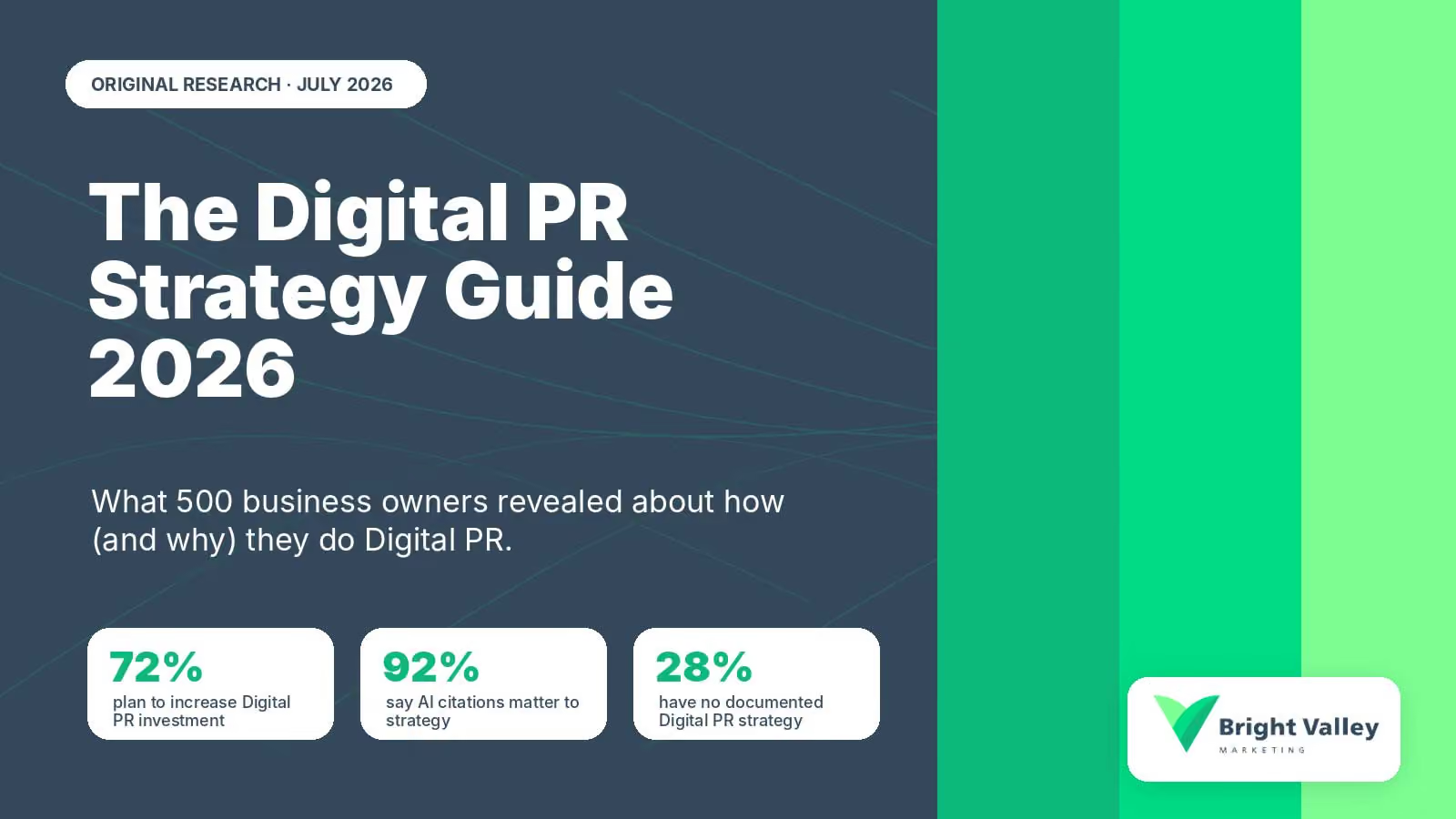
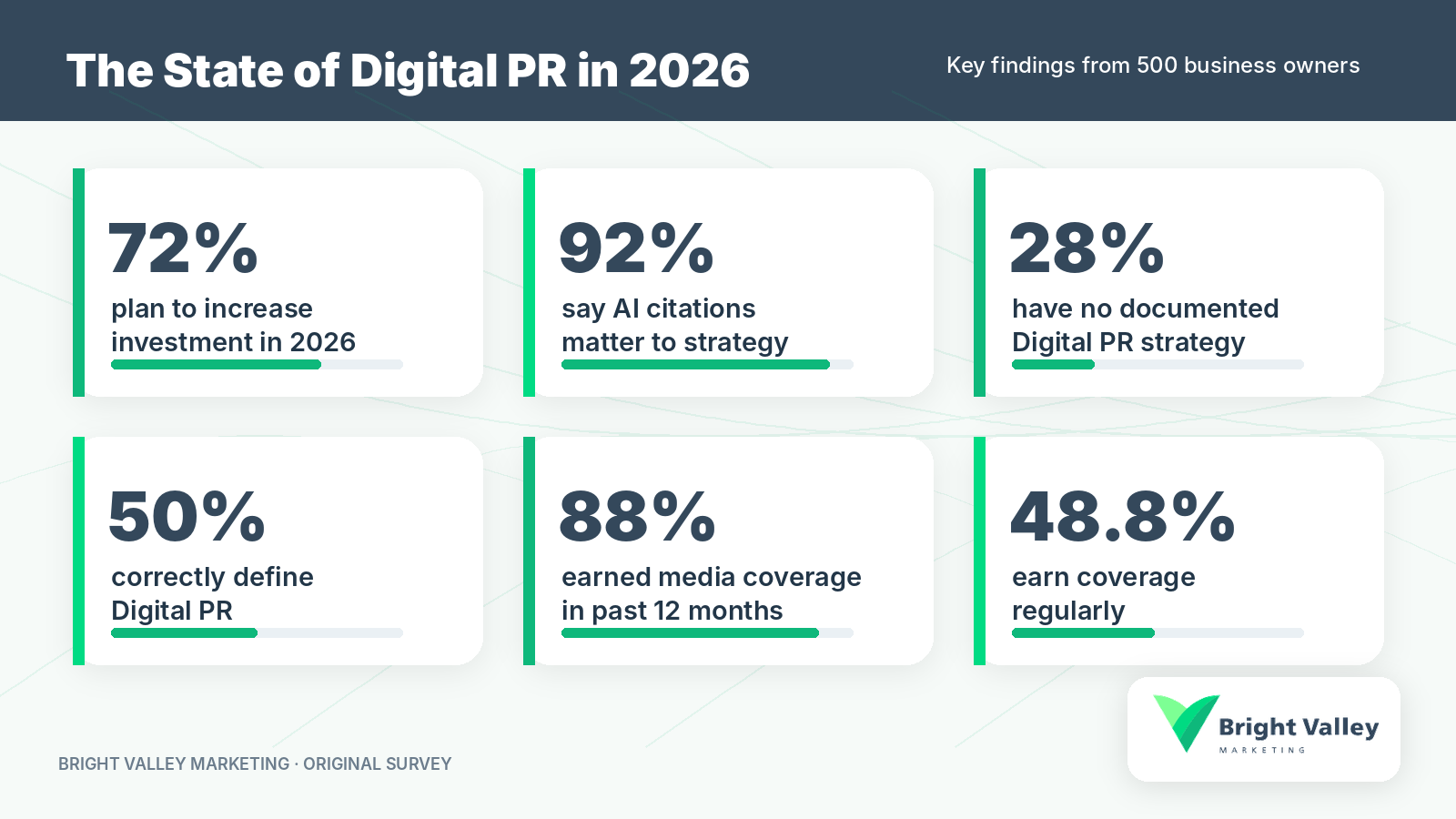
And the demand for Digital PR is surging: our latest survey uncovered that 72% of businesses plan to increase their digital PR investment in 2026.
But we also found the fundamentals haven’t caught up with the enthusiasm as more than 1 in 4 businesses (28%) still have no documented digital PR strategy, and half don’t even define digital PR correctly.
To map the gap between ambition and execution, we surveyed 500 business owners and marketing decision-makers in July 2026.
This guide pairs that original data with a practical, six-step framework you can use to build (or sharpen) your own Digital PR strategy.
The State of Digital PR in 2026: Key Findings
Our survey of 500 business owners and marketing leaders surfaced seven findings worth your attention:
- 28% have no documented digital PR strategy — 25.7% run an informal approach and 2.5% have none at all.
- Only 50% correctly define digital PR — the other half confuse it with press releases (24.6%), social media (20.2%), or paid ads (4.8%).
- 72% plan to increase digital PR investment in 2026 — 32.6% significantly, 39.5% slightly.
- 92% say being cited by AI tools matters to their marketing strategy — 44.9% call it critically important.
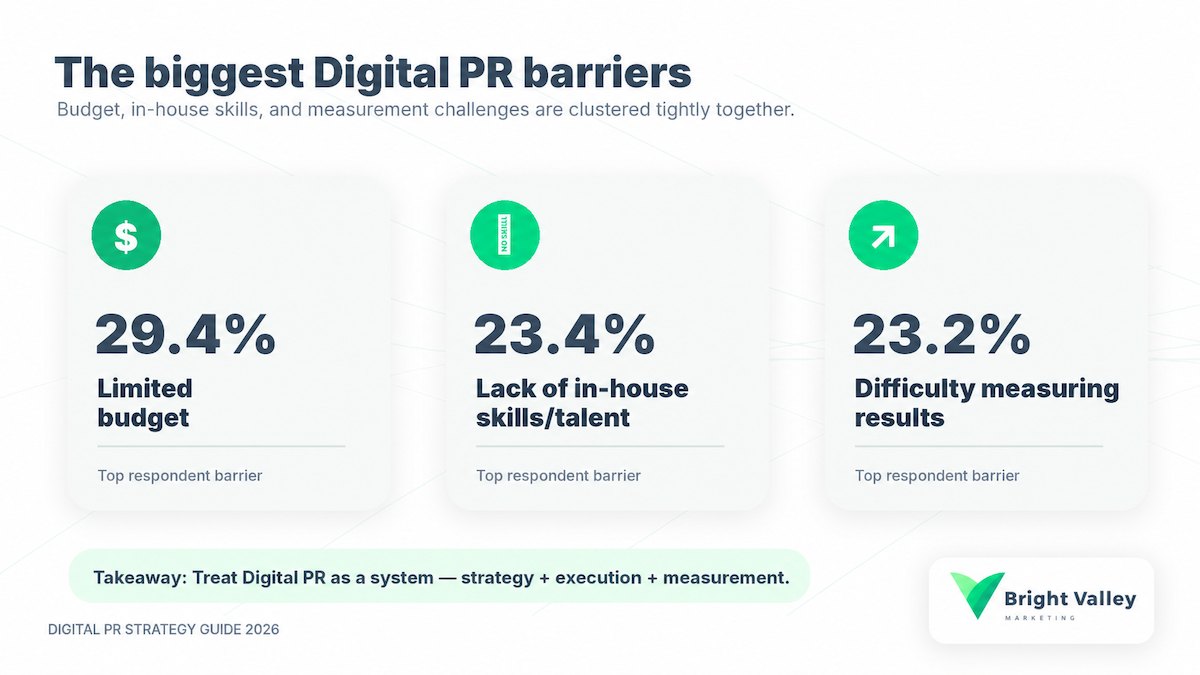
- The single biggest barrier is limited budget (29.4%), followed closely by lack of in-house skills (23.4%) and difficulty measuring results (23.2%).
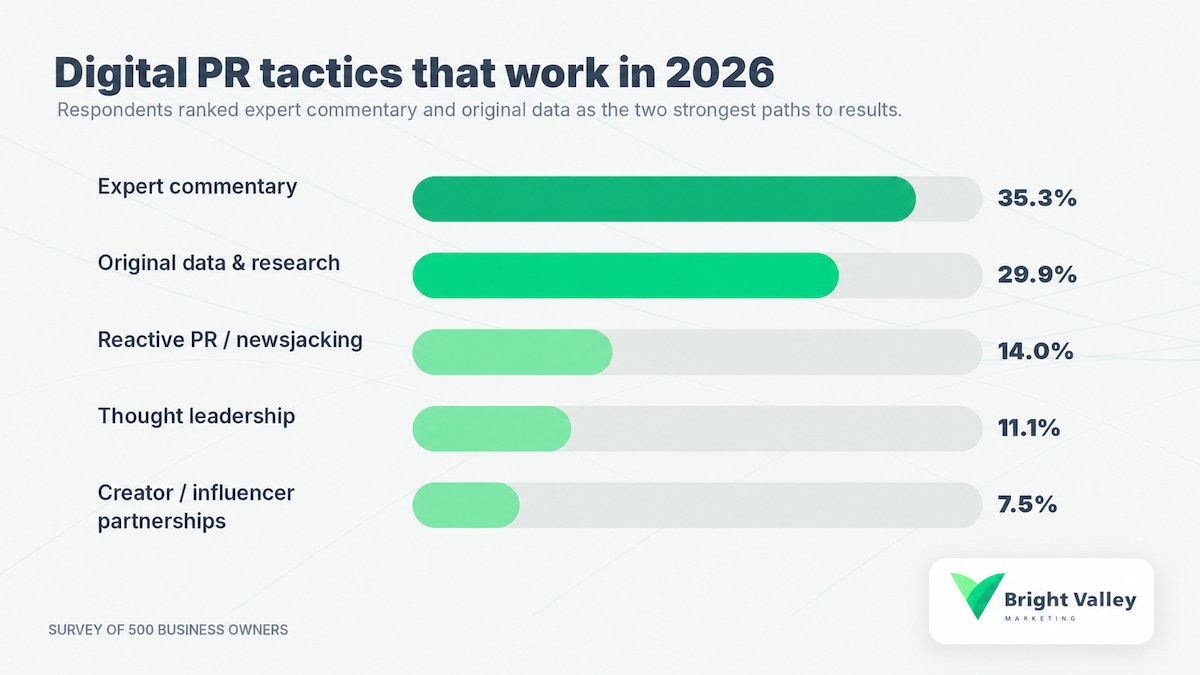
- Expert commentary is the top-performing tactic (35.3%), narrowly ahead of original data/research studies (29.9%).
- 88% earned media coverage in the past 12 months — but only 48.8% do so regularly.
What Digital PR Actually Is (and What It Isn’t)
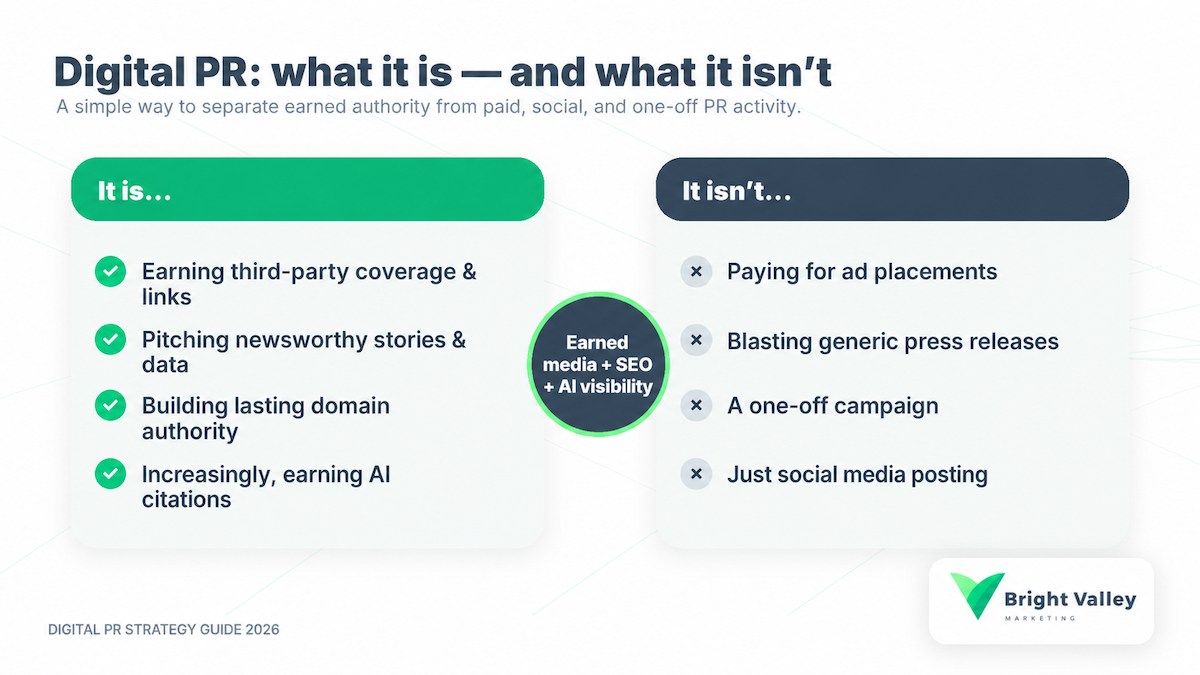
Digital PR is the practice of earning online coverage, backlinks, and brand mentions from credible publications and websites to build authority, improve search visibility, and shape reputation.
It’s widely misunderstood — in fact, only 50.1% of the people we surveyed defined it correctly.
Nearly a quarter (24.6%) equated it with sending press releases, 20.2% with posting on social media, and 4.8% with paid advertising.
The distinction matters:
Where traditional PR chases print and broadcast, and link building narrowly targets backlinks, digital PR sits at the intersection — earning media coverage that also delivers SEO and AI-visibility value.
Why You Need a Digital PR Strategy
Here’s the gap our data exposed: 28% of businesses operate without a documented digital PR plan — a quarter of them (25.7%) winging it with an informal approach.
The result is predictable:
Effort scatters across one-off pitches, campaigns launch without clear goals, and the ROI of these campaigns is difficult to measure.
A documented strategy connects every pitch to a goal, every campaign to a metric, and every placement to a business outcome.
And the stakes are rising – with 72% of businesses increasing digital PR spend in 2026, the undocumented 28% risk pouring more money into a channel they can’t steer.
The 6-Step Digital PR Strategy Framework
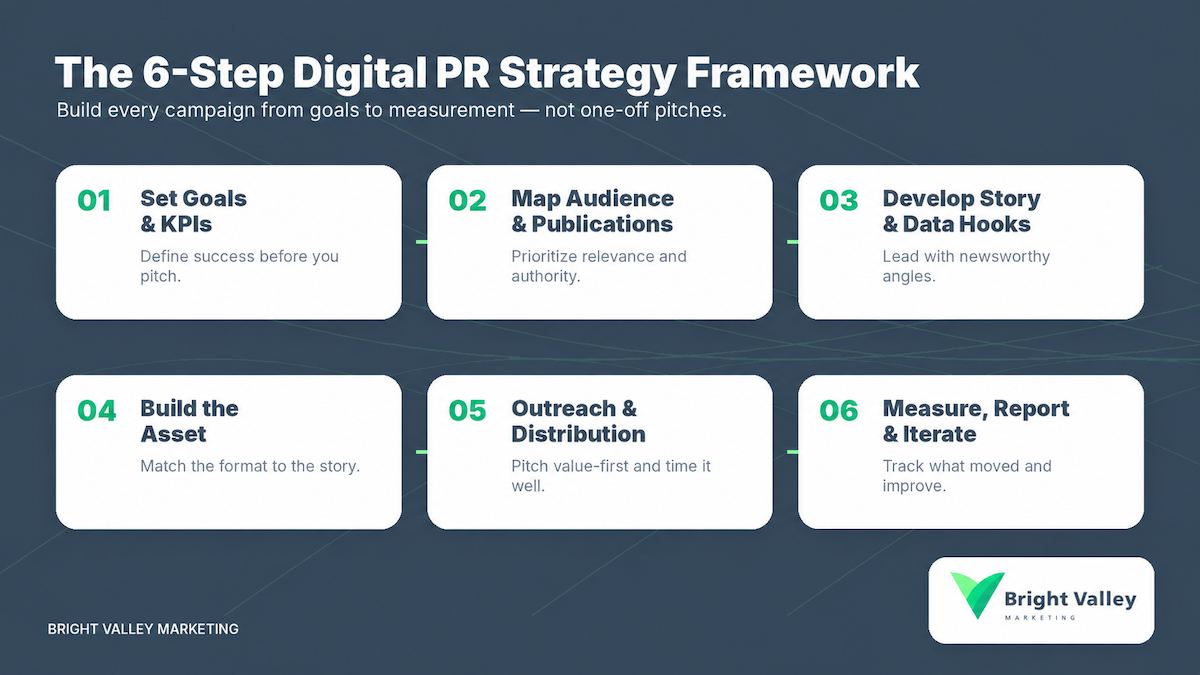
1. Set Clear Goals and KPIs
Define success before you pitch.
Among our respondents, the top goals were building brand awareness & authority (31.9%), generating leads/sales (31.1%), and improving SEO/search rankings (21.7%).
Pick yours, then tie each to a metric you’ll actually track.
2. Map Your Audience and Target Publications
Identify who you need to reach and which journalists, publications, and websites influence them. Keep in mind that most of your coverage will come from general consumer publication (think Daily Herald, ABC News, etc).
Build a target media list ranked by relevance and authority.
3. Develop Story Angles and Data Hooks
The strongest campaigns always lead with something newsworthy.
Digital PR Campaigns based on original data/research was the choice for 29.9% of respondents — while expert commentary camapigns led overall at 35.3%.
Build angles that matter to a journalist’s audience, not just to you (an industry study/report is NOT newsworthy; while it may land coverage in a few industry specific outlets, it probably won’t get picked up by general consumer media).
4. Draft the Press Release and/or Linkable Assets
Turn your angle into something pitchable: a data study, expert commentary, a reactive/newsjacking take, or a thought-leadership piece. If you’re doing an expert commentary campaign or reactive campaign, you won’t need a linkable asset in most cases.
If you’re doing a data study, you should always have a linkable asset ready to pitch. This makes your campaign more citation-worthy.
5. Outreach and Distribution
Pitch relevant journalists your press release with concise, value-first bullet points summarizing the key findings of your campaign. If you’re pitching a regional media outlet, lead with the data that’s local to that region.
6. Measure, Report, and Iterate
Track coverage, referring domains, rankings, referral traffic, and AI mentions. Report against your Step 1 goals, learn what landed, and feed it into the next campaign.
Digital PR Tactics That Work in 2026
When we asked respondents which tactic delivers the best results, the ranking was clear:
- Expert commentary (35.3%) — responding to journalist requests (HARO-style) for fast, credible placements. The #1 tactic.
- Original data & research studies (29.9%) — the most linkable and citable; these are the exact type of Digital PR campaigns our team at Bright Valley Marketing specializes in.
- Reactive PR / newsjacking (14.0%) — inserting your brand into breaking conversations.
- Thought leadership (11.1%) — bylined insight that builds long-term authority.
- Creator/influencer partnerships (7.5%) — extending reach into engaged audiences.
Together, expert commentary and original data account for 65% of best-performing results — a clear signal of where brands should focus.
How to Measure Digital PR ROI
Measurement remains a soft spot: while 42.8% are very confident they can measure digital PR ROI and 37.2% somewhat confident, nearly 1 in 5 (19.5%) are not confident or can’t measure it at all.
And the metrics businesses lean on are scattered – media placements (22.6%), search rankings (19.6%), backlinks/referring domains (16.5%), and AI/brand mentions (15.5%).
Here are the metrics you should be tracking:
1. Number of referring domains (the clearest signal of authority gained)
Count the number of unique websites linking to you, not total backlinks.
One link each from NY Post, CBS News, or a major personal finance site is worth far more than 50 links from the same outlet.
How to track it: Ahrefs or SemRush. Set a baseline before your campaign launches, then measure new referring domains 30, 60, and 90 days after.
Real-world example: In May 2026, Bright Valley Marketing helped a consumer finance brand publish a study on how Americans handle unexpected expenses. It earned 45 new referring domains with an average DR of 70
2. Search rankings (i.e. the movement on target keywords after coverage)
Authority from earned links lifts the pages you care about.
Map each campaign to 5–10 target keywords before launch, so you’re not guessing later about what moved.
How to track it: A rank tracker (again Ahrefs or Semrush) with a snapshot taken pre-campaign.
Real-world example: A travel company commissioned Bright Valley Marketing in March 2026 to run a data study ranking the USA’s most underrated spring break destinations. Sixty days after the coverage landed, its “[destination] tour packages” pages climbed from page two to positions 3–5, organic visibility the brand would otherwise have to pay for, click after click.
3. Referral traffic (i.e. visitors arriving from earned placements)
Not every placement sends traffic, and that’s fine. But when one does, you want to know which publication, which story angle, and what those visitors did next.
How to track it: Google Analytics 4 → Reports → Acquisition → Traffic acquisition, filtered to “Referral.” Create a segment for your earned placements so they don’t get lost in the noise.
Real-world example: The major publication TimeOut featured the destinations study for our client and sent 15,800 visitors to the client’s website in a single week. 4% of them browsed the client’s tour pages, and a handful joined the email list. That placement did double duty: links and demand.
4. Brand mentions, including AI citations
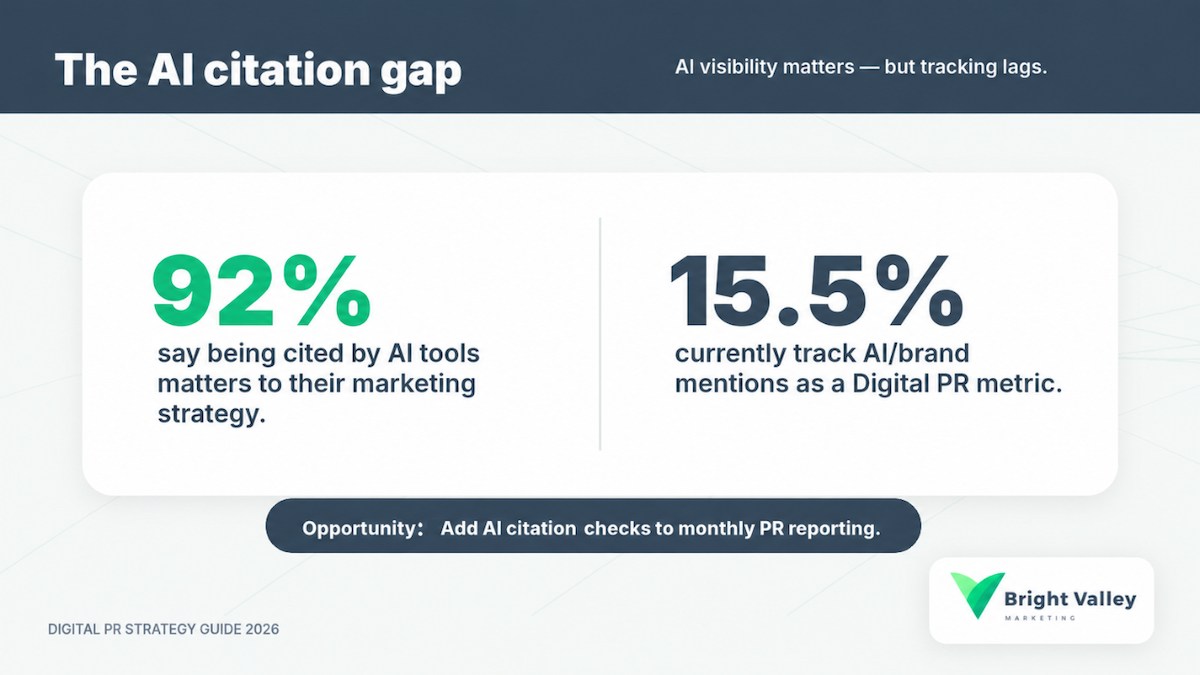
Are you showing up in ChatGPT, Perplexity, and Google AI answers? A striking 92% of respondents now rate AI citations as important, yet only 15.5% currently track them – the single biggest measurement gap in our survey.
How to track it: Start simple. Once a month, ask ChatGPT, Perplexity, and Gemini the questions your customers ask (“how do people cover emergency expenses,” “best guided tours in Arizona”) and log whether your brand appears and which pages get cited. Make sure you’re using temporary chat to ensure you’re getting unbiased results. Keep in mind that results can vary based on a number of factors, so take these with a grain of salt.
Tools like Profound, Otterly, and Ahref’s Brand Radar (our preference) can automate this at scale.
Real-world example: In May 2026, Bright Valley Marketing helped a personal finance website run an original study on emergency expenses. It got cited in Perplexity’s answer to a high-intent financial question. This provided our client with visibility their competitors can’t buy – and a direct, reportable outcome of Digital PR.
5. Leads and revenue attributed to PR (the bottom-line metric!)
Digital PR is rarely last-click, so don’t expect it to show up neatly in your CRM.
Use a blend of first-touch attribution, branded search volume growth, and the simplest tool of all: asking “How did you hear about us?” on your lead forms.
How to track it: GA4 conversion paths, CRM source fields, and branded search trends in Google Search Console. A rise in branded searches in the weeks following major coverage is one of the most reliable proxies for PR-driven demand.
Real-world example: In January 2026, we ran a Digital PR campaign for a law firm, earning them 25 placements. They saw their branded searches jump 35% and leads from organic traffic tick up the following month. Even without perfect attribution, the before/after trend gives you a revenue story to put next to the campaign cost.
Putting it together: a simple ROI report
Report against the goals you set in Step 1, on a one-page scorecard:
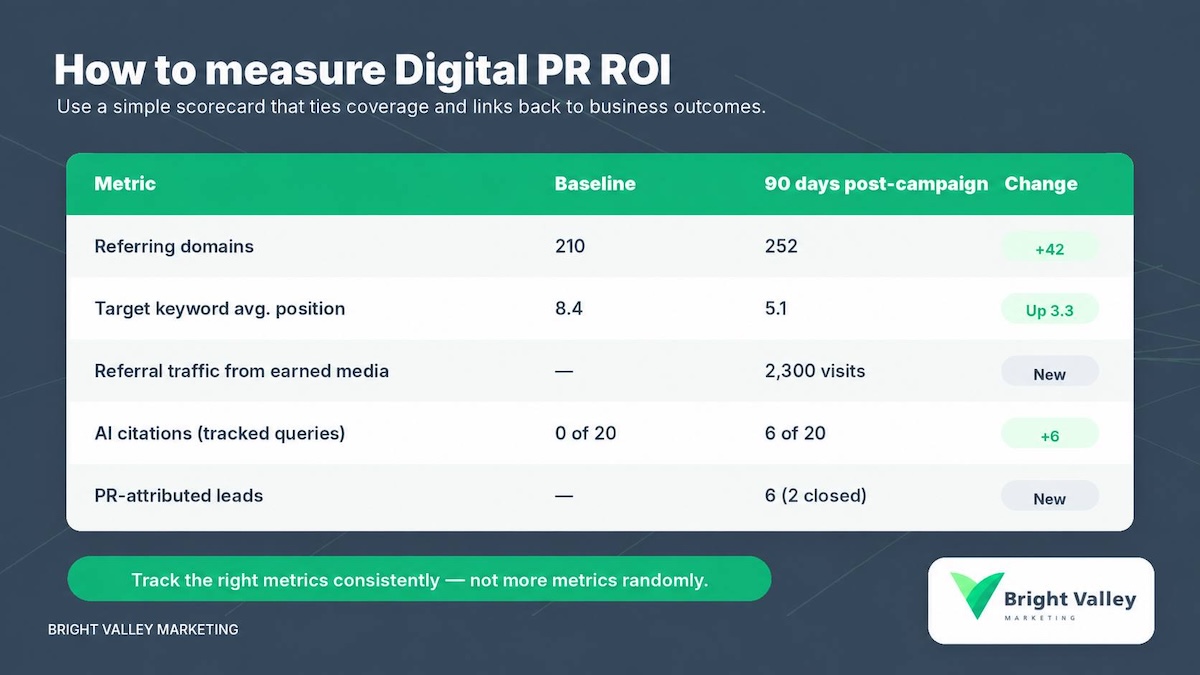
If a campaign cost $8,500 and those two closed deals are worth $20,000, the ROI conversation gets a lot easier – and that’s before counting the compounding value of the links and rankings that keep working after the campaign ends.
The Most Common Digital PR Mistakes and Barriers
When we asked what holds businesses back, the top barriers were limited budget (29.4%), lack of in-house skills/talent (23.4%), and difficulty measuring results (23.2%) – a near three-way tie.
The most common mistakes that flow from these:
- No documented strategy — the root issue behind the 28% operating without one.
- Chasing links over stories — pitching what you want instead of what’s actually newsworthy.
- No measurement framework — leaving nearly 20% unable to prove or improve results.
- Treating it as a one-off campaign rather than an ongoing program.
- Ignoring AI visibility — 92% say it matters, but only 15.5% measure it.
In our open-ended responses, the frustrations were remarkably consistent.
As one respondent put it: “My biggest frustration with digital PR is the difficulty of proving ROI in a clear, measurable way.”
Another: “It’s difficult to consistently earn high-quality media coverage that leads to measurable results.”
Bottom Line
The data tells a clear story: demand for digital PR is booming: 72% are increasing budgets this year and 92% care about AI citations – but the fundamentals lag:
28% have no documented strategy, half misunderstand what digital PR is, and 1 in 5 can’t measure its ROI.
That gap is your opportunity.
Use the six-step framework above, lead with expert commentary and original data, and measure relentlessly — starting with the AI citations almost everyone values but almost no one tracks.
Need help building a digital PR strategy that earns coverage, links, and AI citations? Explore our Digital PR services, and contact us to schedule a no-obligation strategy call.
Methodology
Bright Valley Marketing surveyed 500 business owners and marketing decision-makers in July 2026. Respondents held roles ranging from business owners, founders, and C-suite executives to VPs and Heads of Marketing, Marketing Managers, and marketing specialists/coordinators — all screened for direct involvement in their organization’s marketing or PR decisions. Company sizes spanned 1–10 employees (17.9%) to 1,000+ (6.9%). Results carry a margin of error of approximately ±4.4% at 95% confidence. When citing this research, please link to this page.